
What is RERA and Why is it Essential for Home Buyers? (2026 Ultimate Guide)
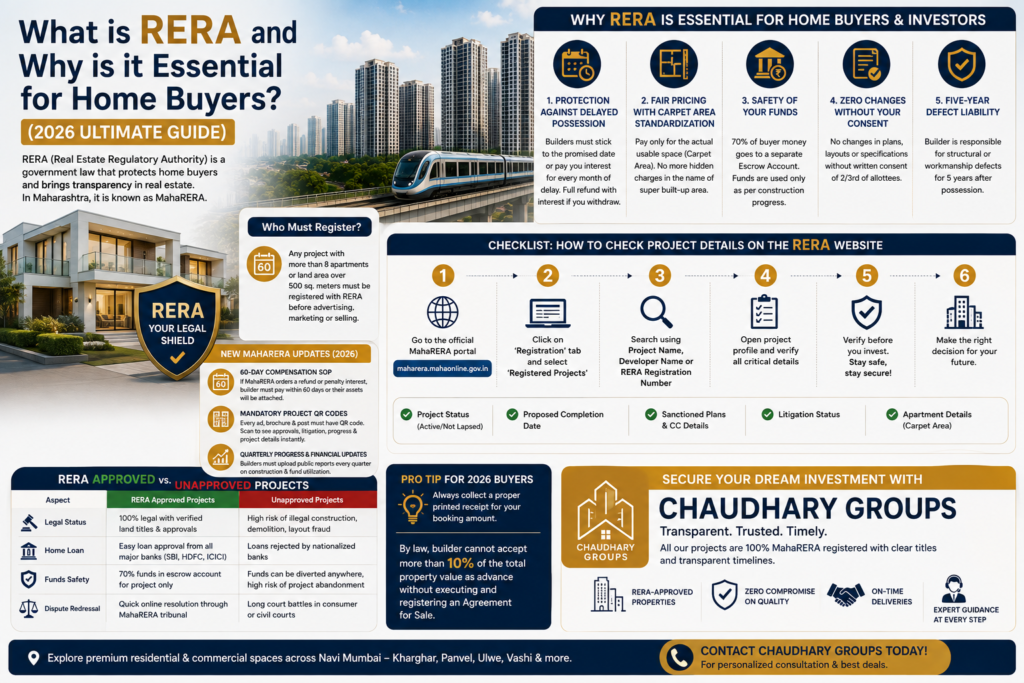
Buying a home is one of the biggest financial decisions of your life. Whether you are a first-time home buyer looking for a family apartment in Vashi or an investor eyeing high-yield commercial spaces in Panvel, the real estate market can feel overwhelming. Before 2017, the real estate sector in India was highly unpredictable—full of delayed possessions, hidden costs, and misleading advertisements.
To fix this and protect your hard-earned money, the Government of India introduced the Real Estate (Regulation and Development) Act (RERA). In Maharashtra, this is handled by MahaRERA, which has become the gold standard for buyer protection in the country.
As we navigate the 2026 property market in Navi Mumbai, understanding RERA is no longer optional—it is your ultimate legal shield. Let us break down exactly what RERA is, how it works, and why it is absolutely necessary for every home buyer and investor today.
What is RERA?
RERA stands for the Real Estate Regulatory Authority. It is a dedicated government body established to regulate the real estate sector, bring transparency, and resolve disputes quickly. Every state has its own version of this authority. In Navi Mumbai and the rest of Maharashtra, it is known as MahaRERA.
By law, any builder constructing a project with more than 8 apartments or a land area exceeding 500 square meters must register their project with RERA before they can advertise, market, or sell a single unit. When a project is registered, it receives a unique RERA registration number and a public QR code.
Why is RERA Essential for Home Buyers and Investors?
Before RERA, builders held all the cards. Today, the power has shifted completely to the buyer. If you are exploring upcoming projects in locations like Kharghar, Ulwe, or Airoli, here is exactly why you must only buy RERA-approved properties:
1. Protection Against Delayed Possession
Project delays used to be the biggest nightmare for home buyers. Builders would take your money and push possession dates back by years without any consequences. Under the RERA rules, builders must declare an official completion date on the MahaRERA portal. If the builder misses this deadline, they are legally required to pay you monthly interest for every month of delay. If you choose to withdraw from a highly delayed project, RERA ensures you get a full refund of your money with interest.
2. Fair Pricing with “Carpet Area” Standardization
Previously, builders used confusing terms like “Super Built-up Area” to inflate property prices. They would include common spaces like lobbies, staircases, and lifts into your property cost, leaving you with a much smaller apartment than you expected. RERA dictates that property pricing must be based strictly on Carpet Area, which means the actual net usable floor area inside the inner walls of your apartment. This ensures you pay exactly for the space you live in, with no hidden calculations.
3. Safety of Your Funds (The Escrow Account Rule)
A common trick among developers was “fund diversion.” They would collect money from buyers in Project A and use it to buy land for Project B, leaving Project A starved of cash and incomplete. To stop this, RERA rules make it mandatory for developers to deposit 70% of all buyer collections into a separate Escrow Account, which is a dedicated bank account tracked by the government. This money can only be withdrawn based on the stage of construction, verified by an engineer and a chartered accountant. Your money stays within your project.
4. Zero Changes Without Your Consent
Have you ever booked a flat looking at a beautiful brochure, only to find out later that the builder turned the promised green park into a new parking tower? Under RERA, developers cannot make any changes to the sanctioned building plans, layouts, or structural specifications without the written consent of at least two-thirds (2/3rd) of the allottees or buyers in that specific project.
5. Five-Year Defect Liability (Construction Quality Assurance)
What happens if you move into your brand-new home in Roadpali and notice major wall cracks or water leakage after six months? The RERA rule states that the developer is responsible for any structural or workmanship defects for five years after handing over possession. This means the builder must fix these issues within 30 days of your complaint, entirely free of charge.
New MahaRERA Updates Every Buyer Must Know
MahaRERA has introduced stricter rules to safeguard your real estate investments. One major update is the 60-Day Compensation SOP, which means if MahaRERA orders a developer to pay you a refund or penalty interest, the builder must clear that payment within 60 days of the order. Non-compliance results in the immediate attachment of the builder’s assets.
Additionally, there are Mandatory Project QR Codes. Every newspaper ad, social media post, or brochure must display the project’s unique QR code. You can scan this code with your smartphone to instantly view the project’s legal approvals, litigation history, and actual construction progress. Builders are also strictly monitored through Quarterly Progress & Financial Updates, meaning they must upload public reports every quarter detailing exactly how much construction is finished and how your money is being utilized.
Checklist: How to Check Project Details on the RERA Website
Do not rely solely on glossy brochures and smooth-talking sales executives. Follow this step-by-step process to verify any property on the official MahaRERA website before paying your booking amount:
First, go to the official portal at maharera.mahaonline.gov.in. Second, click on the ‘Registration’ tab and select ‘Registered Projects’. Third, search for the property using the project name, developer name, or the unique RERA registration number.
Once the project profile opens, verify these critical details: check the Project Status to ensure it is marked as “Active” and not flagged or extended; check the Proposed Completion Date to note the date the builder has committed to the government; check the Sanctioned Plans to see if the Commencement Certificate (CC) has been issued for your specific building wing or floor; review the Litigation Status to see if there are any ongoing court cases or legal disputes over the project land; and finally, cross-verify the Apartment Details to check the exact carpet area of the flat configuration you are purchasing.
Pro Tip for 2026 Buyers: Always collect a proper printed receipt for your booking amount. By law, a builder cannot accept more than 10% of the total property value as an advance without executing and registering a formal Agreement for Sale.
RERA Approved vs. Unapproved Projects: What is the Difference?
When comparing RERA approved projects to unapproved projects, the legal status is vastly different. RERA approved projects are 100% legal with verified land titles and local municipal clearances, whereas unapproved projects carry a high risk of illegal construction, demolition notices, or layout fraud.
For home loan approvals, major banks like SBI, HDFC, and ICICI offer quick, hassle-free loan approvals for RERA registered properties, but nationalized banks will completely reject home loan applications for unapproved ones.
In terms of financial transparency, 70% of funds are secured in an escrow account solely for construction in approved projects, while unapproved developers can divert your funds anywhere, increasing project abandonment risks. Finally, for grievance redressal, approved projects offer quick online dispute resolution through the MahaRERA tribunal, while unapproved projects leave you stuck in lengthy, expensive court battles in consumer or civil courts.
Conclusion: Your Next Steps to a Secure Home
RERA has turned the dream of safe homeownership into a reality. It eliminates guesswork and brings total transparency to your investment. However, the law only protects those who choose to be informed. As a home buyer or smart investor in Navi Mumbai, your first question to any real estate developer must always be: “What is your RERA registration number?”
Secure Your Dream Investment with Chaudhary Groups
Are you looking for transparent, legally clear, and premium residential or commercial spaces in Navi Mumbai? At Chaudhary Groups, we believe in 100% compliance, zero compromises on construction quality, and timely deliveries. All our upcoming and ongoing projects are fully registered under MahaRERA with transparent timelines.