
Property Rates Before And After Navi Mumbai Airport: The Ultimate Guide for First-Time Home Buyers & Investors
The Navi Mumbai real estate market is currently the most talked-after topic across the Indian property landscape. Whether you are a first-time home buyer searching for a dream home for your family or a smart investor looking to securely grow your wealth, you have undoubtedly heard about the Navi Mumbai International Airport (NMIA).
There was a time when people viewed Navi Mumbai merely as a quiet neighbor or a distant sister city to Mumbai. Buyers used to hesitate before moving here because connectivity was a significant challenge. However, the situation has completely turned around. With the rapid development of the airport and its commercial operations nearing completion, the local real estate market has experienced a massive surge.
The biggest question on every buyer’s mind is: What were property rates like before the Navi Mumbai Airport was officially announced, and how much have prices jumped now that the airport is becoming an active reality? In this comprehensive guide, we will analyze the complete data and pricing trends so you can make an informed decision at the right time.
The Pre-Airport Era: When Navi Mumbai Was an Affordable Backup Option
Let us step back a bit to the time when the Navi Mumbai International Airport existed primarily on paper. The period between 2010 and 2018 can comfortably be categorized as the “Pre-Airport Era.” During this phase, real estate rates across Navi Mumbai were significantly lower and highly affordable compared to contemporary pricing.
1. The Buyer’s Perspective
In those days, buyers considered only core areas like Vashi, Nerul, and Belapur as premium nodes. Kharghar was still in its steady development phase, while localities like Ulwe, Panvel, Dronagiri, and Taloja were widely perceived as remote, isolated, and highly underdeveloped. People generally bought homes in these pockets only when their budget fell short of purchasing a home in main Mumbai or Thane.
2. Property Rates in the Pre-Airport Phase
Looking back at the average pricing around 2015–2016 reveals a stark contrast to modern values:
Ulwe and Kamothe: Property rates in these areas ranged between a modest ₹4,000 and ₹5,500 per sq. ft. A decent 2 BHK apartment was easily accessible within a budget of ₹40 Lakhs to ₹50 Lakhs.
Panvel: It functioned largely as a conventional residential town where property values hovered around ₹4,500 to ₹6,000 per sq. ft.
Kharghar: Despite being the most meticulously planned node developed by CIDCO, premium properties were available at highly accessible rates of ₹7,000 to ₹8,500 per sq. ft.
During this period, investors enjoyed a relaxed timeline. The market moved at a slow, predictable pace. Because the general public assumed the airport would take decades to complete, there was no sign of panic buying or aggressive speculation.
The Transition & Current Era: The Post-Airport Real Estate Boom
The entire market dynamic shifted drastically once construction on the airport ground began moving at an aggressive pace. Simultaneously, the completion of mega-infrastructure lifelines like the Atal Setu (MTHL) and the operational Navi Mumbai Metro Line 1 turned concepts into reality.
Today, the direct impact of the airport is visibly written all over property pricing. Let us break down the core transformations observed in the market:
1. Massive Capital Appreciation
Locations that were once treated as secondary backup options have emerged as highly sought-after premium hubs. Over the last few years, several prominent pockets across Navi Mumbai have recorded a staggering 80% to 150% capital appreciation.
2. Evolution of Premium Integrated Townships
The airport influence has accomplished more than just raising real estate prices; it has completely elevated the lifestyle standard of the region. Standalone building structures are rapidly giving way to massive integrated townships spanning 40 to 100 acres. Built by top-tier developers, these communities feature high-end swimming pools, expansive clubhouses, and automated smart security setups as standard offerings.
Before vs After: A Detailed Area-Wise Price Analysis
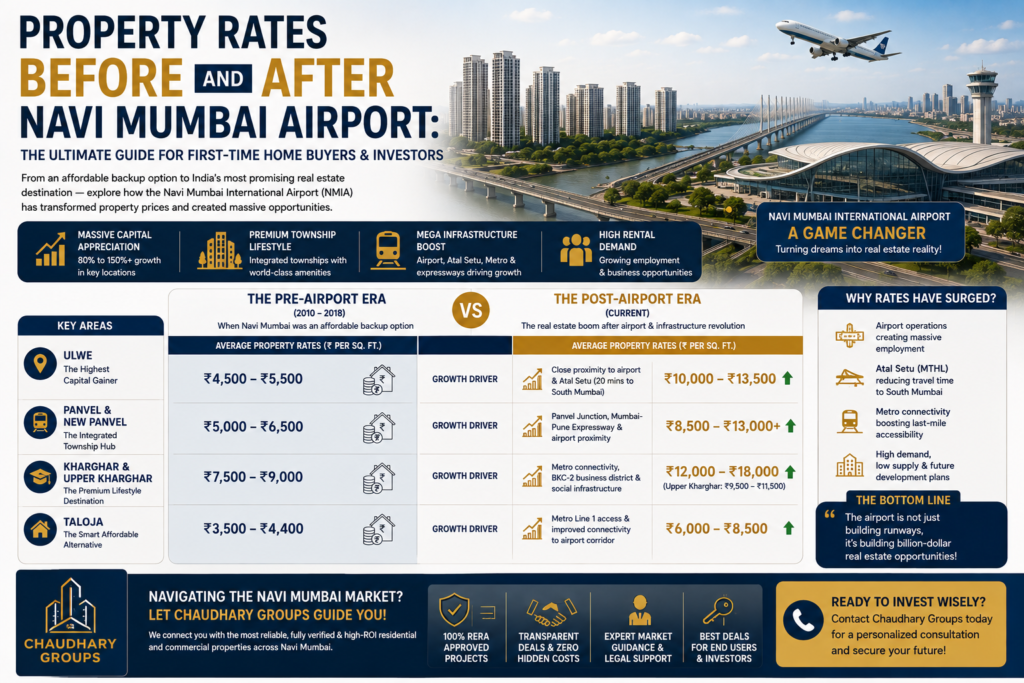
To give you a clearer picture of the financial growth, here is a detailed breakdown of the prime residential nodes situated directly within the airport’s growth corridor:
1. Ulwe – The Highest Capital Gainer
Geographically positioned as one of the closest residential nodes to the airport site, Ulwe has experienced unprecedented growth.
Before the Airport (2015-2017): Average rates stood between ₹4,500 and ₹5,500 per sq. ft.
After the Airport (Current): Today, average property prices have scaled up significantly to ₹10,000 to ₹13,500 per sq. ft.
The Growth Driver: Absolute proximity to the airport combined with the Atal Setu—allowing residents to reach South Mumbai (Sewri) in just 20 minutes—has turned Ulwe into a highly lucrative real estate hotspot.
2. Panvel & New Panvel – The Integrated Township Hub
Panvel was historically known as a transit hub, but the arrival of the airport has massively accelerated its residential valuation.
Before the Airport: Standard market rates hovered around ₹5,000 to ₹6,500 per sq. ft.
After the Airport: Current property valuations range widely between ₹8,500 and ₹13,000 per sq. ft., scaling even higher within premium gated communities.
The Growth Driver: The presence of the Panvel Railway Junction, direct access to the Mumbai-Pune Expressway, and proximity to the new airport terminals have collectively made it a magnet for premium township developments.
3. Kharghar & Upper Kharghar – The Premium Lifestyle Destination
Kharghar remains the undisputed educational, institutional, and cultural capital of Navi Mumbai.
Before the Airport: Standard rates moved within a stable range of ₹7,500 to ₹9,000 per sq. ft.
After the Airport: Core sectors of Kharghar are commanding premium rates of ₹12,000 to ₹18,000 per sq. ft., while emerging projects in Upper Kharghar range around ₹9,500 to ₹11,500 per sq. ft.
The Growth Driver: Superior metro connectivity and the upcoming business blueprint of BKC-2 (Corporate Business District) have strongly reinforced its premium market standing.
4. Taloja – The Smart Affordable Alternative
Taloja has rapidly opened up as an excellent destination for buyers looking to avoid the high pricing of central nodes.
Before the Airport: Entry-level prices sat comfortably between ₹3,500 and ₹4,400 per sq. ft.
After the Airport: Average residential values have steadily climbed to ₹6,000 to ₹8,500 per sq. ft.
The Growth Driver: Direct access to the Metro Line 1 network and improved transit paths to the airport corridor have turned Taloja into the ultimate budget-friendly zone for first-time buyers.
🔑 Navigating the Navi Mumbai Market? Let Chaudhary Groups Guide You!
Purchasing real estate is never just a simple financial transaction—it is the culmination of your life’s hard work, savings, and long-term dreams. At Chaudhary Groups, we connect you with the most reliable, fully verified, and high-ROI residential and commercial properties across Navi Mumbai. Backed by our rich legacy of market expertise and absolute transparency, we ensure you secure the absolute best deals with complete peace of mind.