
Before Development vs. After Development
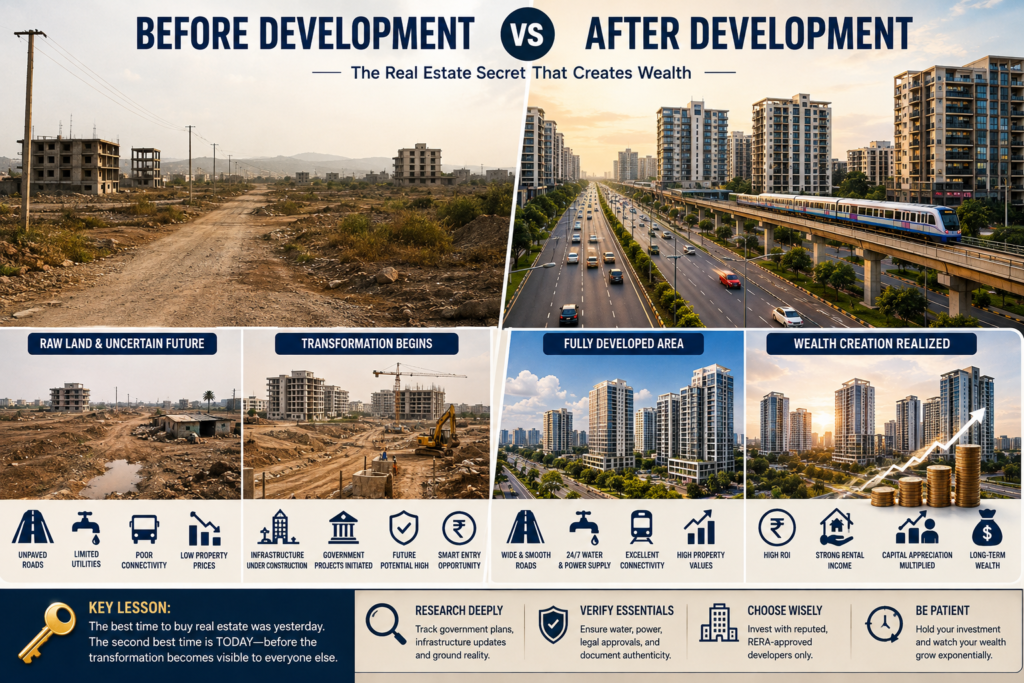
Let’s be completely honest. If you’ve ever driven past a patchy, dusty area on the outskirts of a growing city and thought, “There’s absolutely nothing here, why would anyone buy this?”—you are not alone. In fact, that is exactly what 90% of people see.
But while the majority focuses on what is missing, a tiny group of seasoned investors is busy quietly buying up plots and flats in that exact same mess.
When you look at an area before development, you see empty fields, broken or unpaved roads, barely any shops, and a frustrating lack of public transport. Most buyers look at this and say, “I’ll wait until it gets a bit more developed.”
The problem? By the time the area looks pretty and perfect, the boat has sailed. The cheap entry prices are gone forever.
If you want to understand how massive wealth is actually generated in real estate, you need to understand the brutal reality of the Before vs. After price reset.
📌 WHAT does the market look like “Before Development”?
Before a micro-market explodes, it usually looks like an active construction zone. The roads are half-made, civic utilities like municipal water lines are still being laid on-ground, and the neighborhood feels way too quiet at night.
From a lifestyle standpoint, it looks unattractive. But from a wealth-creation standpoint, this is the golden hour.
Because demand is low and the general public is too scared to buy into discomfort, prices are at rock-bottom baseline levels. You aren’t paying a premium for fancy cafes or working metro stations because they don’t exist yet. At this stage, you are buying the developer’s blueprint and the government’s infrastructure promises. You are buying based on what the area will become, not what it is today.
📍 WHERE does the massive price gap actually happen?
To understand how drastically prices change once the infrastructure goes live, you don’t need fancy whitepapers. You just need to look at how real-world Navi Mumbai micro-markets transformed over their development cycles.
Take Ulwe, for example. Back in its “Before Development” phase around 2021, it felt disconnected, raw, and unpaved. You could easily grab a property there for roughly ₹5,200 per sq. ft. Fast forward to 2026, with the Atal Setu (MTHL) fully active and the Navi Mumbai International Airport running commercial flights, Ulwe has transitioned into its “After Development” phase. Today, those exact same pockets command anywhere between ₹11,500 to ₹13,500 per sq. ft.
We see the exact same story playing out in Taloja. It started as a raw industrial fringe with properties selling for ₹3,800 per sq. ft. Now, as the Navi Mumbai Metro network integrates it directly with Kharghar, prices have climbed straight into the ₹6,800 to ₹8,000 per sq. ft. bracket.
The second buyer—the one who waited for the metro to start running and the roads to be smooth—is now paying nearly double the price for the exact same square footage.
🛠️ HOW do you safely invest before the development happens?
Investing in a developing market doesn’t mean you blindly drop your savings into any random jungle. It requires a strategic approach to manage the risk of delays. Here is how you execute this play like a pro:
1. Separate “Paper Promises” from Ground Reality
There is a massive difference between a broker saying “A metro is coming here”and the government actually allocating a budget and digging up the roads. Look for areas where infrastructure projects have passed the litigation/land acquisition stages and are actively under construction. The “ugly construction stage” is the safest time to buy because the project is guaranteed to finish, but the price premium hasn’t kicked in yet.
2. Audit the Absolute Bare Essentials
An area can survive without a luxury shopping mall for three years, but it cannot survive without water and electricity. Before buying into an upcoming zone, physically check if the local authority (like CIDCO or NAINA) has already laid down the primary water pipelines and power grids. If the existing buildings in the area are entirely dependent on private water tankers, proceed with extreme caution.
3. Stick to Tier-1 Developers to Avoid Delays
When you buy “Before Development,” your biggest enemy is time. If a small-time builder delays your project by five years, the surrounding market might mature, but your capital remains locked up fruitlessly. Pay a slight premium to stick with well-capitalized, RERA-approved corporate developers who have the financial muscle to finish the project on time.
🔑 The Bottom Line (TL;DR)
What: Real estate wealth isn’t made by buying a finished product. It is made by absorbing the temporary discomfort of a developing area and watching the price reset once certainty hits.
Where: Look at real-world examples like Ulwe and Taloja—the biggest wealth generation happened during the transition from raw transit blueprints to active corridors.
How: Don’t buy blindly. Track active government construction, verify core utilities like municipal water lines on-ground, and choose trusted builders to protect your timeline.